What Is Tai Sui? The Chinese Zodiac’s Annual Guardian Deity Explained

Every year, as Chinese New Year approaches, you may notice a familiar name appearing in conversations about the Chinese zodiac: Tai Sui.
Some people talk about clashing with Tai Sui. Others mention praying to Tai Sui for protection or wearing a traditional blessing charm. If you are new to Chinese culture, it can all sound a little mysterious.
Is Tai Sui a god? Why does it change every year? And what does it have to do with your birth year?
Tai Sui is an important part of traditional Chinese Taoist belief and folk culture. Its history goes back many centuries, and its connection with the Chinese zodiac is more interesting than you might expect.
Let’s take a closer look.
1. What Is Tai Sui?

AI-generated illustration of a Tai Sui deity.
Tai Sui (太岁), sometimes called the Grand Duke of Jupiter or the Year Deity, refers to a group of deities in traditional Chinese Taoist belief.
In this belief system, there are 60 Tai Sui deities, each associated with one year in a traditional 60-year cycle. One deity takes charge of each year, becoming that year’s presiding Tai Sui.
This annual deity is known as the Year Tai Sui, or Zhi Nian Tai Sui (值年太岁).
Traditionally, people believe that this deity oversees the year’s affairs and has a connection with the fortunes and well-being of people during that year.
But Tai Sui is not simply another name for the Chinese zodiac.
The zodiac has 12 animal signs, while the Tai Sui system has 60 deities. The two are connected through the traditional Chinese calendar, but they serve different roles.
Think of it this way: the zodiac gives each year its animal sign, while the Tai Sui system assigns a presiding deity to that year.
And yes, that means the annual Tai Sui changes. It is not the same deity working every year!
2. Where Did the Belief in Tai Sui Come From?
The story of Tai Sui did not begin with the 60 guardian deities we see in Taoist temples today.
Its early history is connected with how ancient Chinese people understood time, the changing years, and the natural order of the world.
In early Chinese traditions, Tai Sui was also known as Sui Yin (岁阴), a calendrical concept associated with the passage of years. It was not originally understood as the group of human-like guardian deities seen in later Taoist traditions.
Early Chinese traditions included the concept of Tai Sui as an important force associated with the passage of years. Over time, this idea developed into a religious belief.
Historical records and research describe several important stages:
Early traditions: An idea connected with the passing of years
The concept of Tai Sui appeared in ancient Chinese writings. Early references were connected with traditional timekeeping and beliefs about the influence of the year.
At this stage, Tai Sui was not yet the familiar group of 60 human-like guardian deities found in later Taoist traditions.
The Northern Wei period: Worship became more established
Historical records describe the establishment of dedicated worship for Tai Sui during the Northern Wei dynasty.
This marked an important step in the development of Tai Sui from an ancient belief into a deity associated with religious ceremonies.
The Song dynasty: Tai Sui became more human-like
During the Song dynasty, Tai Sui deities increasingly appeared with human identities and personalities.
Rather than being understood only as an unseen force associated with the year, they were represented as individual divine figures.
The Yuan and Ming dynasties: The 60-deity system took shape
Over time, the relationship between Tai Sui and the 60-year calendar cycle became more established.
The system of 60 Tai Sui deities, each assigned to a particular year, developed into a recognizable form in later Taoist tradition.
This is why the Tai Sui figures seen in temples today often have individual names, titles, and appearances.
The belief evolved over many centuries. It was not created all at once.
3. Why Are There 60 Tai Sui Deities?

To understand this, we first need to know a little about the traditional Chinese calendar.
In Chinese culture, years are traditionally named using two sets of symbols:
- Ten Heavenly Stems (天干)
- Twelve Earthly Branches (地支)
These are combined in a repeating sequence to create 60 unique combinations, known as the 60 Jiazi (六十甲子).
The cycle begins with Jiazi (甲子) and ends with Guihai (癸亥). After 60 combinations, it starts again.
Each combination represents a year in the traditional calendar and is associated with one of the 60 Tai Sui deities.
This is also why the same zodiac animal returns every 12 years, but its full traditional year designation takes 60 years to repeat.
For example, the Year of the Goat returns every 12 years. However, each Goat year has its own Heavenly Stem and Earthly Branch combination.
This creates a much larger cycle than the 12 zodiac animals alone.
A simple way to remember it:
- 12 zodiac animals represent the familiar animal signs.
- 60 Jiazi combinations form the traditional 60-year cycle.
- 60 Tai Sui deities correspond to the years in that cycle.
The Chinese zodiac is only one part of a much older calendar tradition.
4. What Is the Difference Between Year Tai Sui and Birth-Year Tai Sui?
This is where things become especially interesting.
In traditional Taoist belief, Tai Sui is connected not only with the current year but also with the year in which a person was born.
There are two important terms to understand.
Year Tai Sui (值年太岁)
This is the deity assigned to the current year.
For example, 2027 is traditionally the Year of the Fire Goat (Ding Wei, 丁未). Under the 60-year Tai Sui system, this year has its own presiding Tai Sui deity.
People traditionally pay attention to the Year Tai Sui when welcoming a new lunar year.
Birth-Year Tai Sui (本命元辰)
Your birth year also has a corresponding combination in the 60 Jiazi cycle.
In Taoist tradition, this is known as your Ben Ming Yuan Chen (本命元辰).
It is associated with your personal birth-year deity, rather than the deity presiding over the current year.
This explains why Tai Sui is not only a yearly topic. It also has a personal connection with an individual’s birth year.
For example, two people born in different years may have different birth-year Tai Sui associations, even if they share the same zodiac animal in a broader 12-year cycle.
The 60-year cycle provides a more detailed distinction.
5. What Does It Mean to Clash with Tai Sui?
You may have come across the expression Fan Tai Sui (犯太岁) when reading about the Chinese zodiac.
It is often translated as “clashing with Tai Sui,” although the traditional meaning is broader than a direct clash.
In Chinese folk belief and traditional astrology, it describes certain relationships between a person’s birth-year Earthly Branch and the current year’s Earthly Branch.
These relationships are traditionally grouped into several categories:
- Zhi Tai Sui (值太岁): When a person’s zodiac year matches the current year’s zodiac year. It is also commonly associated with one’s Ben Ming Nian, or birth zodiac year.
- Chong Tai Sui (冲太岁): A direct opposition between the person’s zodiac sign and the year’s zodiac sign.
- Xing Tai Sui (刑太岁): A traditional relationship associated with tension or conflict between certain Earthly Branches.
- Po Tai Sui (破太岁): A relationship traditionally associated with disruption or damage.
- Hai Tai Sui (害太岁): A relationship traditionally associated with hidden difficulties or interference.
These categories come from traditional Chinese astrology and folk belief.
They do not mean that someone is destined to experience bad luck. Rather, they describe how certain zodiac-year combinations are traditionally interpreted.
It is also worth remembering that the complete traditional calendar system is more detailed than simply matching two animal signs.
That is why Chinese zodiac compatibility and Tai Sui relationships are not always the same thing.
6. Why Do People Pray to Tai Sui?

AI-generated illustration of a traditional Tai Sui prayer ceremony.
If Tai Sui is associated with the year’s fortunes and a person’s birth year, it is understandable that people developed customs around showing respect and seeking blessings.
One of the best-known traditions is Bai Tai Sui (拜太岁), or praying to Tai Sui.
Another related practice is An Tai Sui (安太岁), a traditional ritual intended to seek peace and protection for the coming year.
These practices are commonly associated with the beginning of the lunar year.
Depending on the temple and local tradition, ceremonies may include:
- Offering prayers and incense.
- Writing a prayer document with personal details.
- Paying respects to the current year’s Tai Sui deity.
- Asking for peace, protection, and well-being.
- Lighting a blessing lamp as a symbol of hope for the year ahead.
These customs can be found in different Chinese communities, including communities outside mainland China.
For example, in Singapore, Taoist temples continue to hold annual Tai Sui ceremonies. Some temples enshrine all 60 Tai Sui deities, allowing visitors to pay respect to the deity associated with their birth year as well as the current year.
One notable example is Lorong Koo Chye Sheng Hong Temple, which houses the 60 Tai Sui deities in one hall.
For many people, these traditions are not simply about avoiding misfortune. They are also a way to welcome a new year with respect, reflection, and good intentions.
7. Who Is Yin Jiao, the Marshal of Tai Sui?
You may also encounter the name Yin Jiao (殷郊) when researching Tai Sui.
In some Taoist traditions, Yin Jiao is known as Marshal Yin, or Tai Sui Yuan Shuai (太岁元帅).
He is regarded as the marshal who commands the 60 Tai Sui deities.
An important detail is that Yin Jiao is not one of the 60 annual Tai Sui deities. He is a separate figure associated with their leadership.
His story is also connected with the famous Chinese novel Investiture of the Gods (封神演义).
However, the literary version of Yin Jiao’s story should not be confused with the historical development of Taoist Tai Sui worship or treated as a direct record of Taoist scripture.
For readers discovering Chinese culture, this is a useful distinction: religious traditions, historical records, and popular novels can share the same characters while telling different versions of their stories.
8. Tai Sui Today: An Important Part of Chinese New Year Culture

AI-generated artistic representation of a traditional Taoist Yuanchen Hall.
Today, Tai Sui remains a familiar subject in Chinese zodiac discussions, especially around Chinese New Year.
People often look up their zodiac signs, learn which Tai Sui relationships are associated with their birth years, and explore traditional ways of welcoming the new year.
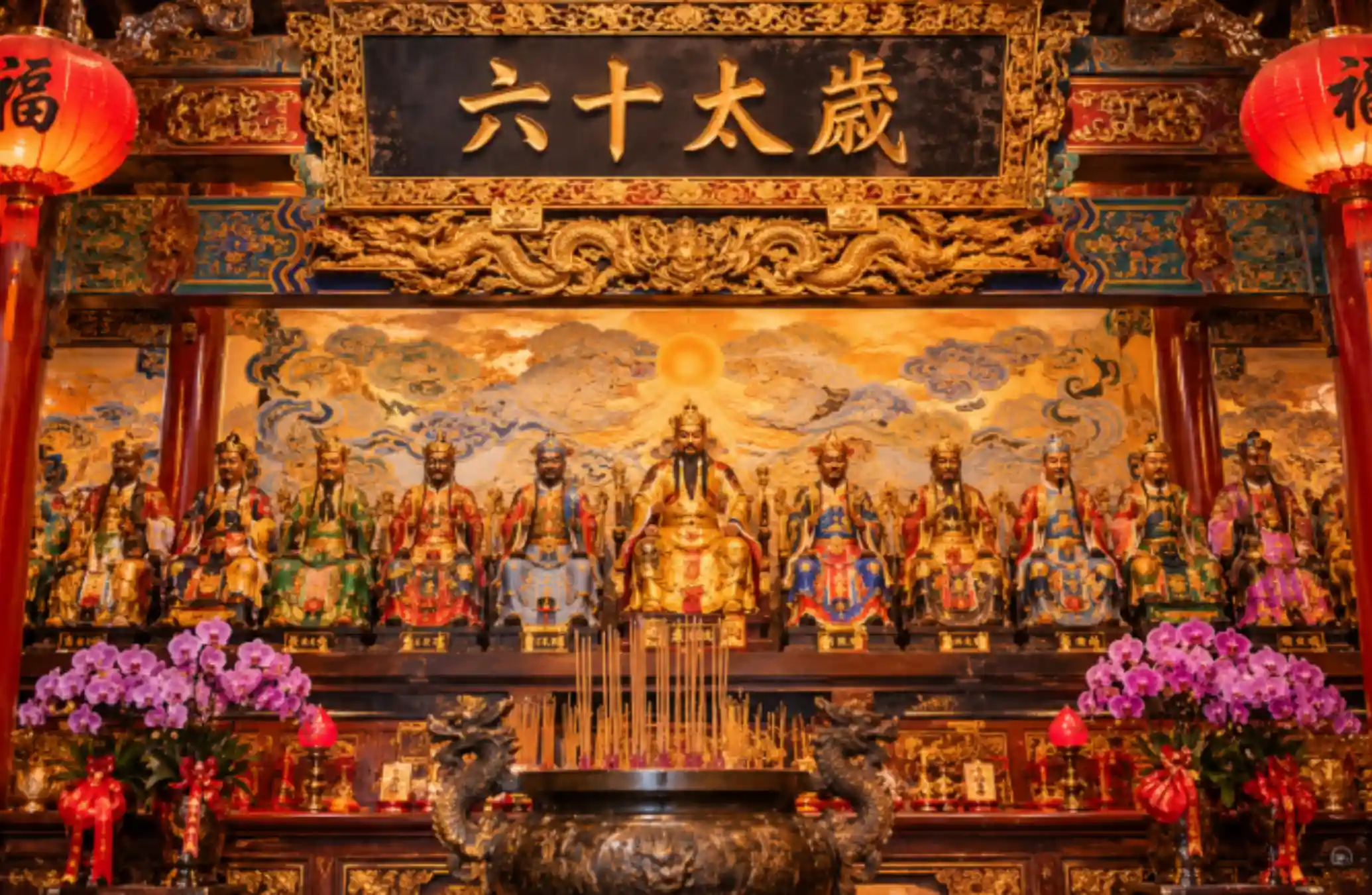
In Taoist temples, the 60 Tai Sui deities are sometimes represented by individual statues, each with a different name and appearance.
One well-known example is the Yuanchen Hall at Beijing’s White Cloud Temple (Baiyun Guan).
The hall is associated with Doumu and the 60 Tai Sui deities. It offers a real-world example of how an ancient calendar tradition became part of Taoist religious space and practice.
For many people, the meaning of Tai Sui goes beyond predicting good or bad fortune.
It is also connected with respect for tradition, hopes for peace, and the wish to begin each new year with a positive mindset.
And perhaps that is one reason why this belief has remained part of Chinese culture for so long.
Final Thoughts: More Than a Zodiac Tradition
Tai Sui is not simply another name for the Chinese zodiac.
It is a traditional Taoist and folk belief that developed over many centuries, connecting the 60-year Chinese calendar cycle with a system of annual and birth-year guardian deities.
Understanding Tai Sui also helps explain why Chinese New Year is about more than welcoming a new zodiac animal. It is a time when many people reflect on the year ahead, pay respect to tradition, and wish for peace and well-being.
Whether you are learning about Tai Sui out of curiosity or exploring your own Chinese zodiac year, there is a fascinating cultural story behind this tradition.
Sometimes, understanding a tradition is the first step toward appreciating the meaning behind it.
Note: Tai Sui and the related practices described in this article are part of traditional Taoist and Chinese folk beliefs. They are cultural and religious traditions, not scientific claims or guarantees about a person’s future.
This article is intended for cultural education and does not replace guidance from Taoist religious practitioners.
References & Further Reading
This article draws on historical records, Taoist research, and cultural studies to explain the development of Tai Sui belief and its place in Chinese tradition.
The following sources offer further reading for those interested in exploring the subject:
- China Taoist Association – Sixty Yuanchen (六十元辰)
An introduction to the 60 Jiazi cycle, birth-year deities, and the development of annual Tai Sui worship.
http://www.taoist.org.cn/getDjzsById.do?id=80 - China News Service – The Cultural Meaning of the Sixty Star Deities (六十星宿的民俗学意义)
A general introduction to Tai Sui traditions, including the folk beliefs surrounding Fan Tai Sui and the development of the 60-deity system.
https://www.chinanews.com.cn/cul/2013/03-04/4613138.shtml - The Hong Kong Taoist Association – A Historical Study of Tai Sui Belief (太岁信仰的历史考辨)
A detailed study of the historical development of Tai Sui worship, annual guardian deities, and traditional ceremonies.
https://www.daoist.org/BookSearch(test)/list012/71-1.pdf - The Hong Kong Taoist Association – Further Discussion on the Origins and Evolution of Tai Sui (再論太歲源起與太歲神格的演變)
Research examining the early origins of Tai Sui belief and its transformation into a Taoist deity tradition.
https://www.daoist.org/BookSearch(test)/list012/59-2-4.pdf - National Chung Hsing University – From Dunhuang Annotated Calendars to Temple Tai Sui Rituals (從敦煌具註曆日到寺廟安太歲)
Academic research on the historical development of An Tai Sui customs and temple rituals.
https://ir.lib.nchu.edu.tw/handle/11455/93578?mode=simple
The sources above are provided for further cultural and historical reading. Interpretations of Tai Sui may vary across Taoist traditions and local customs.